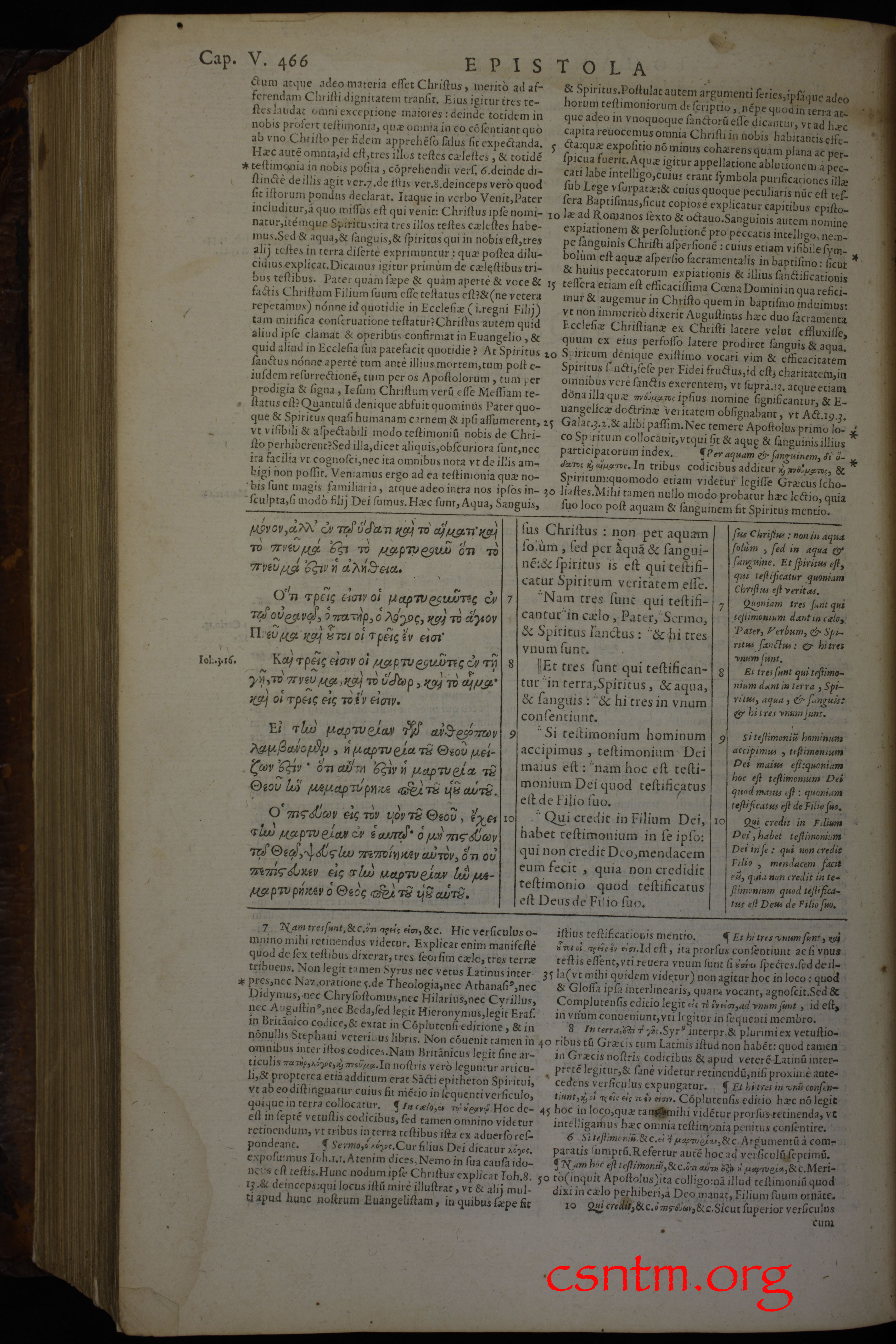
7 For there are three that bear witneƒs in Heaven, the Father, the Word, and the Holy Ghoƒt: and theƒe three are one: 8 And there are three that bear witneƒs in Earth, the Spirit, the Water, and the Bloud: and theƒe three agree in one. --Symon Patrick, 1675 (italics his)
7 For there are three that bear witness in heaven, the Father, the Word, and the Holy Spirit: and these three are one. 8 And there are three that bear witness in earth, the Spirit, the water, and the blood: and these three agree as one. --NKJV (as footnoted)
ότι τρεις εισίν οι μαρτυρούντες εν τω ουρανώ ο πατήρ ο λόγος και το αγίων πνεύμα και ούτοι οι τρεις εν εισί. 8 και τρεις εισίν οι μαρτυρούντες εν τη γη το πνεύμα και το ύδωρ και το αίμα και οι τρεις εις το εν εισίν --Scrivener's TR (italics his)
The italics mark an interpolation, brought into the Greek text in an attempt (actually many attempts, as we shall see) to conform it to what was already in the Latin, when it was noticed that no Greek manuscript contained it [but see UPDATE]. I will attempt to demonstrate below that it was also interpolated into the Latin manuscripts from which it came, as there is no evidence that it ever existed in Greek until it was specifically translated for the purpose from manuscripts of the Latin Scriptures.
Now, Greek and Latin differ in an important way: Greek depends upon definite articles to carry meaning; Latin, on the other hand, doesn't even have definite articles. Therefore anyone attempting to translate from Greek to Latin is forced to drop the articles, but anyone translating from Latin to Greek must supply them. This is precisely what we see when we look at the several manuscripts which contain a Greek translation of the Latin interpolation. There are five with the Comma added to the margins much later than the copying of the manuscript itself, and six manuscripts written with the Comma included in the text. I should add here that four of the latter are but hand-made copies of three different printed editions of the Textus Receptus (and one of these, a combination of two of them). The other two are described below.
There are three primary sources for the Greek version of the Comma. I provide below transcriptions and literal translations of each, along with such idiosyncrasies as I can transmit from facsimiles of the books themselves.The comma is marked off by [].
1. Codex Ottobonianus gr. 298 (Minuscule 629, aka Codex 162), a 14th century Latin/Greek diglot of the Acts and Epistles with the Latin Vulgate in the first column and an adapted Greek text in the second, with Greek corrections in the intervening margin. It is the oldest extant copy of the Comma in the Greek Scriptures; which comma had, a century or so earlier, been included in the Greek translation of the Acts of the Lateran Council (see below). Thus this textual family of the Comma can most likely be traced back to that very document. Observe that no text of the Comma in a Greek copy of First John matches this one, and even here, the Greek Comma doesn't match the Latin one across the page (substantial differences in bold).
Latin:
7 Quia tres sunt qui testimonium dant [in celo, pat., verbum, & spiritus sanctus, et hy tres unum sunt. 8 Et tres sunt qui testimonium dant in ter], spiritus, aqua et sanguis. (omits et hi tres unum sunt)
For three are that testimony give [in heaven: Father, Word, and Spirit Holy; and these three one are. And three are that testimony give in earth]: spirit, water, and blood. (omits the end of v. 8--or rather, inserts it into the comma--the reason for which we shall see anon)
Greek:
7 ότι τρεις εισίν οι μαρτυρούντες [ἀπὸ τοῦ οὐρανοῦ, πατὴρ, λόγος, καὶ πνεῦμα ἅγιον. καὶ οἱ τρεῖς εἰς τὸ ἕν εἰσι. 8 καὶ τρεῖς εἰσὶν οἱ μαρτυροῦντες ἐπὶ τῆς γῆς] το πνεύμα, το ύδωρ, και το αίμα (omits, or rather transposes by substitution, καὶ οἱ τρεῖς εἰς τὸ ἕν εἰσι)
For three are the witness-bearing [from the heaven: father, word, and spirit holy, and the three into the one are. And three are the witness-bearing upon the earth] the spirit, the water, and the blood (same story on the end of v. 8)
And I now have the text of the only surviving manuscript of The Acts of the Lateran Council:
Latin: Quemadmodum in Canonica Joannis epistola legitur, Quia tres sunt qui testimonium dant in cælo, Pater, (et*) Verbum, et Spiritus Sanctus: et hi tres unum sunt. Statimque subjungitur: Et tres sunt qui testimonium dant in terra, Spiritus aqua et sanguis, et tres unum sunt: sicut in codicibus quibusdam invenitur.
*the text is uncertain; one source has et, but it is given to interpolation. The same source, moreover, lacks Sanctus.
Greek: ον τρόπον εν τη κανονική τη ιωαννο επιστολή αναγρωσκίται ότι τρεις εισίν οι μαρτυρούντες [εν τω ουρανώ ο πατήρ λόγος και πνεύμα αγίου]. και τουτοι οι τρεις εν εισίν. ευθυσ τε προστιθησι καθως εν τισι κωδηξιν ευρίσκεται.
Translation of Latin: Moreover in the canonical epistle of John we read, For three are that testimony give in Heaven: Father, (and) Word, and Spirit Holy; and these three one are. After which immediately follows, And three are that testimony give in earth, spirit, water, and blood: and three one are: as is found in some copies.
Translation of Greek: Moreover in the canonical epistle of John is read, For three are the witness-bearing [in the heaven: the Father, Word, and Spirit Holy]; and these three one are. (still working on an exact translation of the closing comment; it appears to be the same as the Latin).
2. The Complutensian Polyglot (so-called), with the Latin Vulgate in one column and an adapted Greek text in the other--making it actually a Diglot in the New Testament volume. The first printing of the Comma in Greek, this was the version included in its manuscript copy, Codex Ravianus, and is close to that in the margin of Minuscule 88.
Latin:
7 Quonium tres sunt oooo ooo qui testimonium dant [in celo: pater: verbum: et spiritus sanctus: & hi ooo oo tres unum sunt. 8 Et tres sunt qui oooo testimoniuʒ dant in terra:] Spiritus agua & sanguis.
For three are that testimony give [in heaven: father, word, and spirit holy, and these three one are. And three are that testimony give in earth] spirit, water, and blood. (same story on the end of v. 8)
Greek:
7 ότι τρεις εισίν οι μαρτυρούντες [ἐν τῷ οὐρανῷ, ὁ πατὴρ καὶ ὁ λόγος καὶ τὸ ἅγιον πνεῦμα, καὶ οἱ τρεῖς εἰς τὸ ἕν εἰσι. 8 καὶ τρεῖς εἰσιν οι μαρτυρούντες ἐπὶ τῆς γῆς] το πνεύμα και το ύδωρ και το αίμα ('omits' καὶ οἱ τρεῖς εἰς τὸ ἕν εἰσι)
For three are the witness-bearing [in the heaven: the father and the word and the holy spirit, and the three agree as one [lit, into the one are]. And three are the witness-bearing on the earth] the spirit and the water and the blood (same story on the end of v. 8)
3. Codex Montfortianus (Minuscule 61), a NT manuscript specially adapted to the Vulgate. Not completed until after the printing of the Textus Receptus, it was the first appearance of the Comma in a solely Greek manuscript. Its Comma, but one of many singular readings, was incorporated into the 1522 edition of the Textus Receptus (and none other). Minuscule 429 has this particular version of the Comma in its margin.
7 ότι τρεις εισίν οι μαρτυρούντες [ἐν τῷ οὐρανῷ, πατὴρ, λόγος, καὶ πνεῦμα ἅγιον, καὶ οὗτοι οἱ τρεῖς ἕν εἰσιν. 8 καὶ τρεῖς εἰσιν οἱ μαρτυρούντες ἐν τῇ γῇ,] πνεύμα, ύδωρ, και αίμα, (omits καὶ οἱ τρεῖς εἰς τό ἕν εἰσι)
For three are the witness-bearing [in the heaven: father, word, and spirit holy, and these the three one are. And three are the witness-bearing in the earth] spirit, water, and blood (without the usual wording from the end of v. 8)
Observe, then, the state of the Johannine Comma in 1522, at the time it first entered the Protestant canon via the Third Edition of Erasmus. It entirely lacked the last clause--or, to put it more precisely, consisted of two separate interpolations bracketing a corrupted transposition. When one looks on the one hand at the first two editions of the Textus Receptus that don't contain the Comma, and on the other hand at the two manuscripts and two editions that do contain the Comma, there is a total disconnect. Only in later editions was the Comma edited in such a way that it could be inserted into the text as a seamless interpolation. And when I say "later editions," I mean that it took over half a dozen unique editions of the Textus Receptus before 1 John 5:7-8 reached its present form! It was a process that itself took nearly a dozen steps both forward and backward, as shown below (I used electronic photofacsimilies of Erasmus 1,2,3,4, Stephanus 3, Beza 3,4, Elzevir1, Hutter, and Scrivener 1,2 to compile this data)--
1. Erasmus 1516, 1519, 1521: 1 John 5, without the Comma, has articles in front of each of the three witnesses.
- Aldus 1518 made no changes to these verses.
- Gerbelius 1521 does not have the comma.
2. The Complutensian Diglot, printed in 1514 and published in 1522: 1 John 5 has articles preceding all three Heavenly Witnesses, but none of the Earthly ones. Moved the ν from the final εισίν in v. 8 to the final one in v. 7, as part of its transposition of the end of v. 8 into the Comma.
3. Erasmus 1522: Under the influence of Codex Montfortianus, printed vv. 7-8 with no articles preceding any of the Witnesses, but restored the 'omission' of the end of v. 8. Kept the ν in the final εισίν of v. 8. In his Latin column, he changed 'verbum' to 'sermo' (Word), a brand new reading of the Latin Comma. This was the only change from the Vulgate text as he printed it.
- Cephalius 1524 and 1526 made no changes to these verses.
- Colinaeus 1534 made no changes to these verses.
4. Erasmus 1527, 1535: restored the deleted articles to v. 7. Reprinted his unique Latin translation in the 2nd column.
- Stephanus 1546, 1549 made no changes to Erasmus, as far as I can determine.
5. Stephanus 1550: Switched around 'spirit' and 'holy' under the influence of the Complutensian Diglot, conflating the two versions of the Comma then in print. Restored the deleted articles to v. 8. Identified the beginning of the Comma with a textual note in the margin showing that none of his manuscripts had the passage, but failed to identify in the earth as part of the Comma--a lapse also in the English Coverdale version. Neither εισί had a final ν.
6. Stephanus 1551: Restored the ν to the final εισίν of v. 8 (this is the only reported textual change in this entire edition). Put the verse division, printed here for the first time, within the Comma.
- Elzevir 1624 and 1633 (which have hundreds of differences between them) made no changes. The second edition was reprinted five times, the last one in 1678--forming a basis for late 18th-century American editions.
- Beza 1565, 1582, 1588, 1598 reprinted Stephaus, with the Comma marked and noted in the margin. Featured yet another new reading in the Latin column, with 'testify' in both verses instead of 'bear witness,' and 'these three agree as one' ending v. 8.
7. Elias Hutter's 1599 6-column polyglot prints the Comma in 12 languages, supplying a translation in parentheses in all languages but Latin and Greek. The Latin text follows the Vulgate, and the Greek text that of Stephanus--but with the addition of and in front of the word. His English text follows the 1583 revision of the Geneva Bible, which uniquely has "in the earth." Neither of these additions were retained in any later editions of the Comma.
8. Scrivener 1887, 1894: Eliminated all the ligatures previously used. Comma marked in italics.
9. The Greek Orthodox Church Patriarchal text of 1904: goes back to the Stephanus 1551 version of the Comma.
10. TBS 20th century: Standardised the spelling of εισίν in both verses for the first time.
The standardization of the printed text came way too late to ensure that the Commas inserted into the margins of older manuscripts would be identical. The most eccentric of these is Minuscule 177, a manuscript of the NT minus the gospels, into the top margin of which the Comma was added in the 17th or 18th century. It is labeled "v.7," but has no article in front of 'heaven', nor does it have the "in earth" portion of the comma, which has been assigned to v. 8. The first word, οτι, was added one line above as a further correction. And all of the words are fully spelled out with no nomina sacra, as in Erasmus' 3rd edition. Other than that(!), it reads the same as the comma in the margin of Minuscule 636.
ότι τρεις εισιν οἱ μαρτυρουντες εν ουρανω: πατηρ, λογος, και πνευμα αγιον, και οἱ τρεις εις τό εν εισιν
for three are the witness-bearing in heaven: father, word, and spirit holy, and the three agree as one (literally, the three in the one are).
One manuscript copy matches Erasmus 1527 exactly in the comma, but--naturally--not in the rest of v. 8. Another two manuscript copies were made of Stephanus 1550, along with the marginal reading of Minuscule 221. This version reads:
7 οτι τρεις εισιν οι μαρτυρουντες [εν τῷ ουρανω: ὁ πατὴρ, ὁ λογος, και τὁ αγιον πνευμα, καὶ οὗτοι οι τρεις εν εισι. 8 και τρεις εισιν οι μαρτυρουντες ἐν τῇ γῇ]το πνεύμα και το ύδωρ και το αίμα και οι τρεις εις το εν εισί
for three are the witness-bearing [in the heaven: the father, the word, and the holy spirit, and these the three one are. 8 and three are the witness-bearing in the earth] the spirit and the water and the blood, and the three agree as one (literally, the three in the one are)
It appears that no two of the extant manuscripts or early editions have the same text of 1 John 5:7-8--not even in translation to English. Disregarding the Greek spelling--which was not standardised until this past century--the present text of v. 7-8 with the interpolation is one that, as far as we can tell, never existed on papyrus, parchment, or paper before the latter part of the sixteenth century, in at least the fourteenth edition of the Textus Receptus. In all these cases, the primary differences are the presence or absence of articles and conjunctions, and the choice of prepositions--primarily the very differences that would emerge in translating from Latin to Greek. But there are also changes in word order, the absence of a word due to parablepsis, duplication of a phrase, and even variously spelled words; in this one verse fragment we have examples of almost every scribal error.
But what is the significance of this? Is there a direct correlation between a passage being interpolated and it being full of scribal errors? It may depend. What factors large in this example is the fact that there were numerous variants in the Latin text of the Comma before it was ever brought over into the Greek text. I give an approximation of the evidence from the Old Latin mss as listed in the UBS4 apparatus (bear in mind that these are dated up to several centuries later than the oldest Vulgate manuscript):
itq
[in terra], spiritus (et) aqua et sanguis. 8 [et tres sunt, qui testimonium dicunt in caelo, pater, verbum et spiritus]
itcitdemitdiv
[in terra], spiritus (et) aqua et sanguis, et hi tres unum sunt. 8 [et tres sunt qui testimonium dicunt in caelo, pater, verbum et spiritus.]
itr
[in terra], spiritus et aqua et sanguis, et hi tres unum sunt. 8 [et tres sunt qui testimonium dicunt in caelo, pater, verbum, et spiritus, et hi tres unum sunt in Christo Iesu.]
itm itp
[in terra], spiritus (et) aqua et sanguis, et hi tres unum sunt [in Christo Iesu. 8 et tres sunt qui testimonium dicunt in caelo, pater, verbum, et spiritus.]
itl
[in terra], spiritus et aqua et sanguis, et hi tres unum sunt [in Christo Iesu. 8 et tres sunt qui testimonium dicunt in caelo, pater, filius, et spiritus], et hi tres unum sunt [in Christo Iesu].
The Comma is not found in the text of any extant Vulgate manuscripts prior to the ninth century, nor in the majority of those extant from before the 12th century. Cassiodorus, a textual critic of the sixth century, published the New Testament with the Old Latin and the Vulgate in parallel columns. To this is credited the ensuing commingling of the two textual traditions. Vulgate manuscripts show various signs of thus having received the interpolation from the Old Latin, all extant manuscripts of which contain it. Some, for example, follow itl--as well as Cyprian and Tertullian in their quotations of the canonical portion of v. 8--reading filius (son) instead of verbum, and this version found its way into at least one medieval translation of the Vulgate, used by the Waldensians. The Second Edition of the Wycliffe Bible also translates filius, but as a gloss, not a literal translation--as can be seen from some manuscripts of the First Edition, where it is introduced as a gloss alongside the literal translation of verbum.
But the Vulgate manuscripts are even more divergent than this. One reads:
Tres sunt qui testimonium dant [in terra], spiritus aqua et sanguis. 8 [et tres sunt, qui testimonium dant in cælo pater verbum et spiritus] et tres unum sunt.
Three there are that give testimony [in earth]: the spirit, the water, and the blood. 8 [And three there are that give testimony in heaven: Father, Word, and Spirit]; and three one are (many, if not most, Vulgate manuscripts omit this last clause from v. 8, but here it is missing from the interpolation in v. 7).
Note that although it is unique in what it includes, the Latin reading in this manuscript follows all the Old Latins in where it's included, being a transposition of what ended up making its way from late texts of the Vulgate into the Greek manuscripts. It's a dislocated text!
The evidence available to us may be sufficient to show how the early version of this interpolation arose--the only mystery yet to be solved is how it got transposed in its final edition--a mystery I here assist to the reader to solve. We begin with the first interpolated phrase, in terra (in earth), seen in a quotation by the sixth-century Bishop Facundus, who wrote:
De Patre et Filio et Spiritu Sancto sic dicit: Tres sunt qui testimonium dant [in terra], spiritus aqua et sanguis, et tres unum sunt. (Of Father, Son, and Holy Spirit, it says: Three there are that testimony give [in earth]: spirit, water, and blood, and three one are). Ironically, he interpreted these as Spirit=The Father, Water=The Holy Spirit, and Blood=The Son. At any rate, we now had 6 witnesses instead of 3, and it was short step to add 'in heaven' to balance the two groups out. Although the Vulgate continued to be copied without the Comma for centuries, more and more scribes were putting it in. Some added the extra witnesses following the three that were already there, some preceding; eventually the latter prevailed. The different Greek versions could in part be due to their being independently translated from varying Latin witnesses.
In early sixth-century Bishop Fulgentius' quotation of John the evangelist, we have the insertion of in coeolo to Facundas' three interpretations. This reads the same as the Declaration of the Council of Carthage in 484:
tres sunt qui testimonium perhibent [in coelo, Pater, Verbum, et Spiritus,] et tres unum sunt.
Codex Ottobonianus, cited above, doesn't appear to have followed the usual Latin order--and the bulk of the subsequent Vulgate texts have done the same. The influence of Thomas Aquinas can also be seen behind dropping et tres unum sunt from most subsequently copied manuscripts of the Comma.
Significantly, no Latin text gives any basis for the presence of the word eis in either triad. But eis is inserted into the Comma on the Greek side to match the eis already in the canonical triad--an dittography carried over into the Complutensian text that changes the meaning from 'the three are one' to 'the three agree as one'. This interpolation-within-an-interpolation was never present in any Latin text until it began to be translated from the Greek of the Textus Receptus into the modern languages of Europe. In the 1550's, Protestants in Geneva were very active in Bible Translation. Among these was Theodore Beza, who provided a Latin translation of the New Testament that was consulted in translating the Geneva Bible. He later translated it into French. All three Bibles reflected the difference between the two triads resulting from the introduction of eis into the text (Beza's French translation in italics):
Nam tres sunt qui testificantur [in coelo, Pater, Sermo, & Spiritus sanctus: & hi tres unum sunt. 8 Et tres sunt qui testificantur in terra], spiritus & aqua & sanguis: & hi tres in unum consentiunt ('& ces trois-la se rapportent en un').The King James version went on to exaggerate that difference by translating μαρτυροῦντες differently for each triad.
Going back about as far as we can to find the Comma in extant manuscripts, one from the late 5th century attributed to Vigilius of Thapsus reads,
in terra, aqua sanguis et caro, et tres in nobis sunt.
in earth: water, blood, and flesh; and three in us are.
Going back just as far, to the very oldest copy of the Vulgate (Codex Fuldensis), there is no Comma:
Quia tres sunt qui testimonium dant, spiritus et aqua et sanguis. Et tres unum sunt.
--even though it contains a prologue to the Catholic Epistles which reads as follows:
. . . illo praecipue loco ubi de unitate trinitatis in prima iohannis epistula, positum legimus in qua est ab infidelibus translatoribus multum erratum esse fidei ueritate, conperimus trium tantummodo uocabula hoc est aquae sanguinis et spiritus in ipsa sua editione potentes et patri uerbique ac spiritus testimonium omittentes, in quo maxime et fides catholica roboratur et patris et fili et spiritus sancti una diuinitatis substantia conprobatur.
. . . "especially in that text where we read the unity of the trinity placed in the first letter of John, where much error has occurred at the hands of unfaithful translators contrary to the truth of faith, who have kept just the three words water, blood and spirit in this edition omitting mention of Father, Word and Spirit in which especially the catholic faith is strengthened and the unity of substance of Father, Son and Holy Spirit is attested."
Note that although in this prologue the three extra witnesses are in the early location following the canonical three, these themselves are not in the order as found in any text of First John! There simply isn't any history of transmission from a specific Latin phrase going forward to a specific Greek phrase, much less one that goes back to a specific Greek original.
Scientist and Biblical Scholar Issac Newton investigated this interpolation in his book Two Notable Corruptions. He wrote,
Lastly it is to be observed that the reading of this text in ancient MSS is very various and uncertain. For this is a most infallible signe that the text has been tampered with & that those who first inserted this testimony knew of no certain authentick reading which they were to follow, but noted it in the margins of their books in such various forms of words as they thought conformable either to Jerome's correction of the text or to his Preface or to such marginal notes as they had seen in other books, & that sometimes without designing to make it part of the text; then the transcribers by these marginal notes corrected the text--some one way, some another--according to the best of their judgments. For as this testimony in some old MSS which want it in the text is found noted in the margin in another hand, so in others the various readings in the text are such as ought to result by transcribing it out of the margins.Perhaps we could restate the opening axiom of this post as follows:
An interpolation which is brought into the text by a multiplicity of transmission streams will exhibit a wide variety of readings in the manuscripts at the end of those streams.It does not logically follow, however, that an interpolation brought into the text by a single scribe will necessarily contain any variants whatsoever, as we saw in the case of 2 Kings 9:4. All the variants of that verse stem solely from translators trying to make sense of it. It was Newton's observation that the path of interpolation was typically, if not invariably, via a marginal note. It is interesting in this regard to observe that most of the cases in which the Comma is found in a Greek manuscript, it is found in the margin. Newton found this to be the same case even in many of the Latin manuscripts.
So, does this mean that every time we come to a multiplicity of variants, we can assume an underlying translated interpolation? Certainly not. There could be other reasons for a multiplicity of readings, or for the lack of a majority reading. For example, the split between ἔχωμεν and ἔχομεν in Romans 5:1 is pretty much right down the middle of the manuscript corpus, whether uncial or minuscule, original hand or corrector--due to the fact that W and O sounded the same in Greek by the time the book of Romans was being copied into the manuscripts we now have. It does not mean that the word in either form is an interpolation, although it's apparent that many scribes couldn't resist the urge to correct what 'didn't look right' in the text before them.
There's another passage with a number of variants, even exhibiting a transposition similar to that in the Comma. In fact, it has way more variants than is typical of passages of that length, 1 Cor 14:34-35 included. It's Matthew 21:29-31:
29 He answered and said, 'I will not': but afterward he repented, and went. 30 And he came to the second, and said likewise. And he answered and said, 'I go, sir': and went not. 31 Whether of them twain did the will of his father?" They say unto him, "The first".
Thus the common reading. But some manuscripts (and all Bibles that still follow the WH text) read this way:
29 He answered and said, 'I (/go), sir,' but did not go. 30 And he came to the second (or other) and said likewise. And he answered and said, 'I will not': but afterward he repented, and went. 31 Which of them twain did the will of his father?" They say, "The last".
A couple of manuscripts even read this way:
29 He answered and said, 'I will not': but afterward he repented, and went. 30 And he came to the second, and said likewise. And he answered and said, 'I, sir: and went not. 31 Whether of them twain did the will of his father?" They say, "The last".
or this way:
He answered and said, 'I go, sir,' but did not go. 30 And he came to the second and said likewise. And he answered and said, 'I will not': but afterward he repented, and went. 31 Which of them twain did the will of his father?" They say, "The first".
And even this is an extreme oversimplification of the evidence. The manuscripts are simply riddled with variants at this section. Even the Vulgate manuscripts are split between the first three versions of the story. Both Origen and Jerome commented on the multiplicity of manuscripts with variant readings here. But no one today proposes that any of the information in these verses was interpolated; they simply disagree on the order. And they disagree on their theories as to why the last two versions don't make sense. Really, the second one doesn't make much sense either--why would the father send his second son if the first one had already gone? I'm quite happy myself with the edition found in most manuscripts.
An early textual critic, Lachmann, did feel that there must be an interpolation here somewhere--but few have agreed on just what it was. It does seem to be clear that editorial tampering with what was already in the text is behind all the variants--not an interpolation.
I don't think much of the axiom that a multiplicity of readings indicates an interpolation--that's simply getting the cart before the horse. The best indication of an interpolation is the discovery of the same block of text at various places in the immediate context of its location in the majority of manuscripts. This is a clear sign that something once written in the margin had been moved into the adjoining text.
Now we're getting to the place where we can pull together all this information and apply it to 1 Corinthians 14:34-45--which, as it happens, has both an alleged multiplicity of readings and a dislocated text.
UPDATE June 2013:
While we now know that the Comma Johanneum did not exist in a Greek-only manuscript prior to finding its way into print, a close perusal of the literature of the centuries in which this question first came up shows that this fact was by no means assumed nor accepted by defenders of the Comma, who expected at any time for a Greek manuscript of earlier centuries to show up containing it. This erroneous thinking was perpetuated due to a misunderstanding of the textual notes in Stephanus--for example, by Calvin, who wrote, "As I see that it is found in the best and most approved copies, I am inclined to receive it as the true reading."
UPDATE August 2016:
I can now refer the reader to an exhaustive treatment of the history of the Johannine Comma as set forth by Grantley Robert McDonald in his second doctoral thesis (2011), in which he presents a historical case for the comma springing from centuries of allegorically interpreting the Three Witnesses as representing the three persons of the Trinity, it being only a matter of time before the passage itself was altered (in numerous ways, as we have shown) to make this more explicit.
An endless loop may be followed by clicking on this link.
UPDATE June 2018:
In the interests of accuracy, I provide here a link to Dallas Theological Seminary's library, which claims that the Colineus edition of 1534 did in fact not have the comma. I can't remember now, a decade later, what my source was that it did, so I'll let DTS have the final word on the matter. At any rate, Colineus provided an early but not lasting break from the standardisation of the Textus Receptus, so it is likely that he did omit the comma on the grounds of it not being in any of the manuscripts he consulted.